Your cart is currently empty!
Oral presentation in the Microbiotec 2025 – Madalena Matos
Title
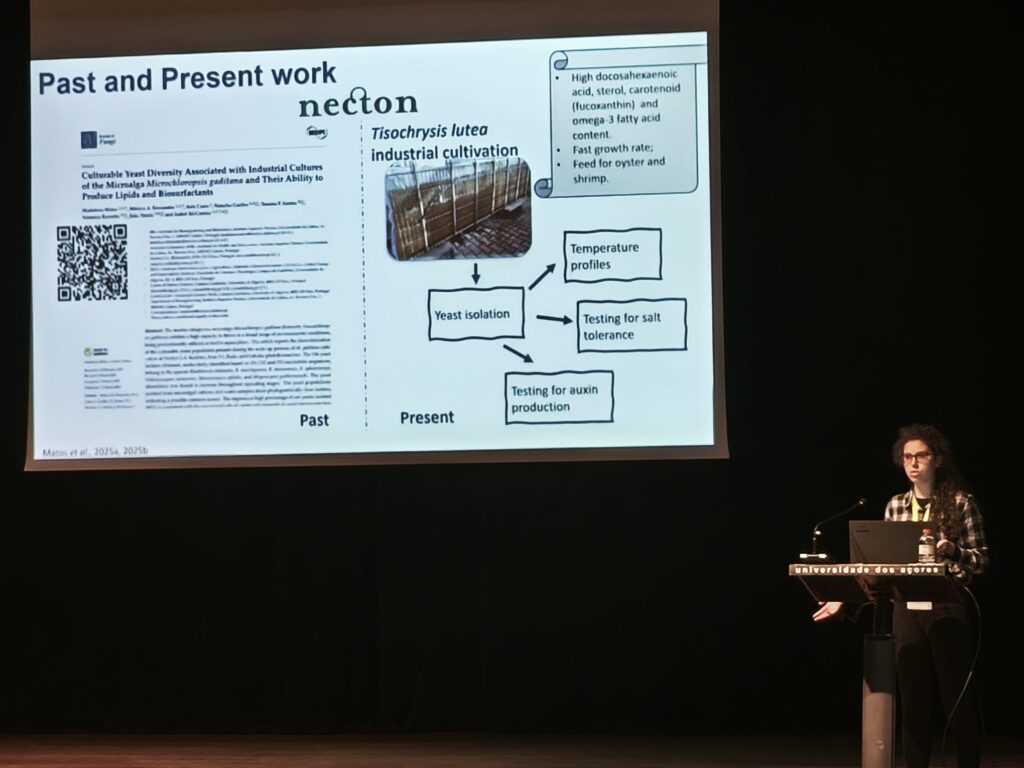
Temperature profiles and auxin production by yeasts associated with industrial microalgal cultures of Tisochrysis lutea
Authors
Madalena Matos, Mónica A. Fernandes, Natacha Coelho, Tamára F. Santos, João Varela, Alexandre M.C. Rodrigues, Isabel Sá-Correia
Abstract
Among marine microalgae, Tisochrysis lutea has emerged as a promising candidate for industrial-scale aquaculture and biotechnological applications. T. lutea is widely used in hatcheries for larval nutrition and has applications in functional foods and nutraceuticals due to its rich composition of omega-3 fatty acids, sterols, and carotenoids. Among the microbiomes associated with industrial microalgae cultures, yeasts represent a particularly interesting group (1). Yeasts may enhance algal productivity by providing essential growth factors or signaling molecules. Through microbiome engineering, co-cultivation strategies, or targeted microbial management, it may be possible to harness beneficial microbiome-microalgae interactions while minimizing negative impacts. Recent results from a study envisaging the isolation of the culturable yeast population in the same industrial setting but in association with Microchloropsis gaditana, revealed a very high percentage of red yeasts with the capacity of producing lipids and biosurfactants and suggested their potential use as probiotics in microalgae production (1). T. lutea large-scale cultivation is still constrained by environmental and physiological factors that limit biomass yield and biochemical productivity. In this context, the use of phytohormones such as indole-3-acetic acid, a naturally occurring auxin, has gained interest as a strategy to enhance microalgal growth and metabolism. Although the effects are complex, emerging evidence suggests that auxins also play growth-promoting roles in microalgae by stimulating photosynthesis, pigment and lipid production and stress tolerance in both freshwater and marine algal species. Yeasts capable of auxin production are promising for enhancing microalgal growth and metabolite production through natural, biologically mediated hormone delivery. This study is dedicated to the isolation and identification of yeast culturable diversity associated with industrial cultures of T. lutea at Necton S.A. facilities, Olhão, Portugal, and to the characterization of temperature profiles, effects of synthetic sea water on growth and auxin production by the isolates obtained. This is a first step towards the exploitation of a co-cultivation alga-yeast strategy for improving bioprocess productivity.
1. Matos, M et al., J. Fungi 2025, 11, 228. https://doi.org/10.3390/jof11030228