Your cart is currently empty!
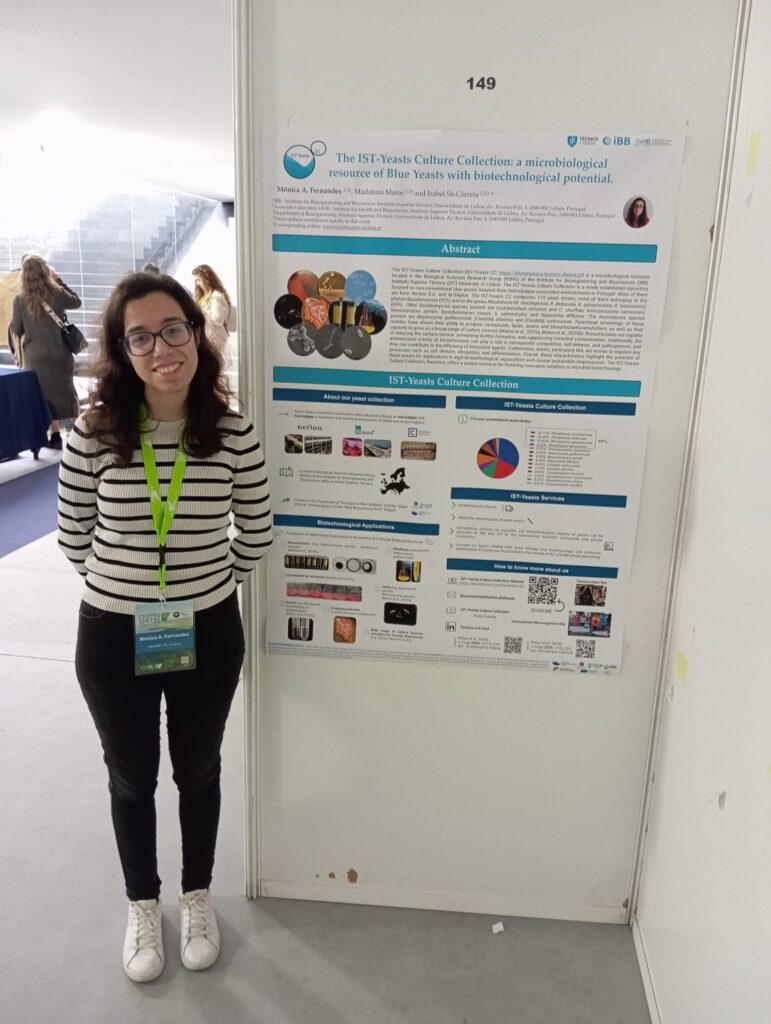
Poster presentation in Microbiotec 2025 – Mónica Fernandes
Title
The IST-Yeasts Culture Collection: a microbiological resource of Blue Yeasts with biotechnological potential.
Authors
Mónica A. Fernandes, Madalena Matos, Isabel Sá-Correia
Abstract
The IST-Yeasts Culture Collection (IST-Yeasts CC) is a microbiological resource located in the Biological Sciences Research Group (BSRG) of the Institute for Bioengineering and Biosciences (iBB), Instituto Superior Técnico (IST) University of Lisbon. The IST-Yeasts CC is a recent collection of nonconventional Blue Yeasts, started during 2023, in the framework of the “Algae Vertical” and the “Portuguese Blue BioBank” work-programs of the PBA (Pacto de bioeconomia Azul) Project. It is a Culture Collection with a focus on yeasts isolated, following an isolation protocol developed to detect this low-abundance population, mostly in association with industrial cultures of microalgae and macroalgae in estuarine and marine environments of Olhão and Aveiro region. Most of them are from Necton S.A. and ALGAplus. The yeast isolates were molecularly identified, and the IST-Yeasts CC comprises 115 yeast strains, most of them belonging to the phylum Basidiomycota (92%) and to the genus Rhodotorula (R. mucilaginosa, R. diobovata, R. sphaerocarpa, R. taiwanensis) (69%). Other Basidiomycota species present are Cystobasidium minutum and C. slooffiae, Vishniacozyma carnescens, Moesziomyces aphidis, Sporobolomyces roseus, S. salmonicolor, and Naganishia diffluens. The Ascomycota species present are Meyerozyma guilliermondii, [Candida] atlantica and [Candida] vartiovaarae. Most of the yeast strains gathered in the IST-Yeasts CC have potential for the (co)production of added-value bioproducts in the context of a Circular Biobased Economy. There are strains capable of using a very wide range of carbon sources and of co-producing biotechnologically relevant lipids and biosurfactants/bioemulsifiers. The red yeasts of the Rhodotorula genus also produce economically relevant carotenoid pigments, particularly torulene and torularhodin. The capacity of many isolates
to co-produce those promising compounds, as well as to produce enzymes and exopolysaccharides, among other relevant bioproducts, based on cultivation on a wide range of carbon sources, makes them very attractive as microbial cell factories in the scope of a sustainable circular bioeconomy. Some of these yeast isolates are also capable of significant auxin production, their use being promising for enhancing algal growth and metabolite production and as probiotics in aquaculture.